

Description
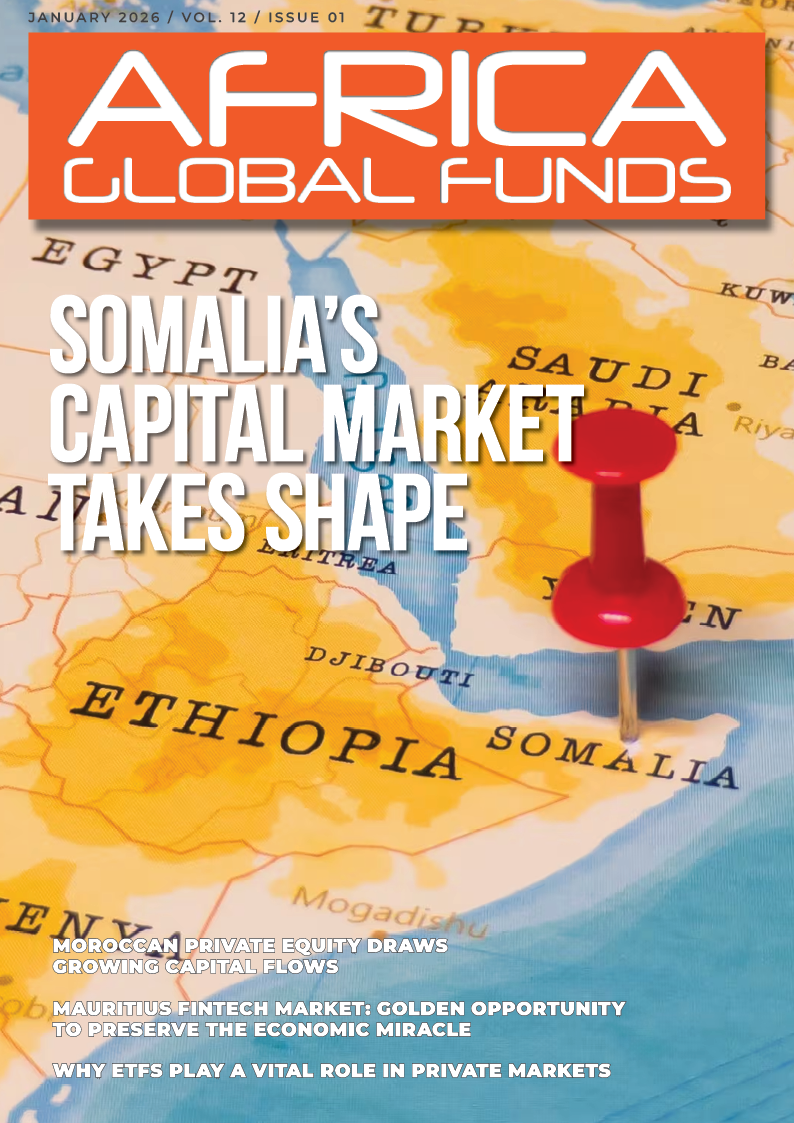
Long powered by private networks, diaspora capital, and an increasingly digital economy, Somalia is now taking a decisive step toward formal public markets with the launch of the National Securities Exchange of Somalia (NSES). In an interview with Africa Global Funds, Yasin M. Ibar, Chief Executive Officer of NSES, outlines how the exchange plans to begin trading in 2026, build investor trust through strong regulation and regional partnerships, and harness Islamic finance, technology, and diaspora participation to create a transparent, liquid frontier market aligned with East Africa and beyond (pp.12-13).
Morocco’s private equity market has grown into North Africa’s leading hub, driven by stability, strong fundraising, and a professionalizing ecosystem. While capital is abundant, deal flow and exits remain limited, prompting initiatives like the Fonds Mohammed VI pour l’Investissement to strengthen governance and expand investable companies. Notable 2025 developments include the oversubscribed Cash Plus IPO and record early-stage funding, signaling growing investor confidence. With supportive policies and a diversifying economy, Morocco is well-positioned for sustained PE growth (pp.14-15).
In this month’s issue, Samar Abuwarda looks into how Mauritius has transformed into a high-income, diversified economy, with financial services driving growth and a 90% financial inclusion rate. Leveraging fintech—especially blockchain, tokenization, and P2P lending—through initiatives like the Mauritius Africa Fintech Hub and MIC, the country can attract global investment, support startups, and boost SMEs (p.16).
Finally, Duma Mxenge of Satrix writes that ETFs help institutional investors access private markets by managing liquidity, easing transitions, reducing costs, and improving transparency. They enable compliance with regulations, support ESG goals, and allow pension funds to gain private-market exposure without operational complexity, making them essential for modern, diversified portfolios (p.22).